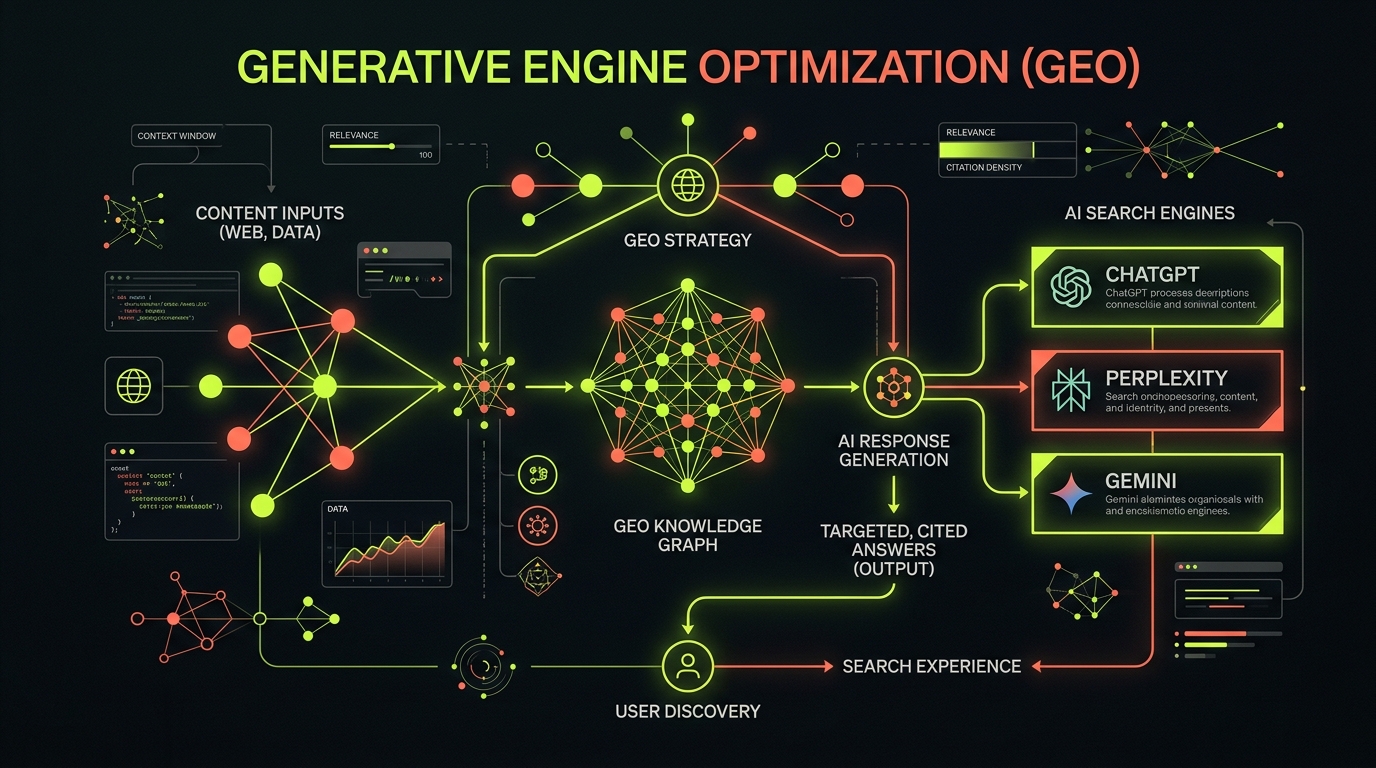
Search has changed. For decades, getting found online meant ranking on the first page of Google. That still matters — but it's no longer enough. A growing share of buyers now turn to AI assistants like ChatGPT, Perplexity and Google Gemini before they ever open a browser tab.
They ask questions like "what's a good Shopify developer for a DTC brand?" or "which digital studio should I use to build my SaaS MVP?" — and the AI answers. If your business isn't cited in those answers, you're invisible to those buyers.
This is where Generative Engine Optimization (GEO) comes in.
What is Generative Engine Optimization?
GEO is the practice of structuring your website, content and entity data so that AI-powered search assistants recommend your business in their synthesised answers. Where traditional SEO focuses on keyword rankings in a list of blue links, GEO focuses on being cited as a trusted source inside an AI-generated response.
Key Takeaway: The Shift from Blue Links to LLM Citations
AI engines don't rank pages — they read, evaluate, and synthesise content across trusted entities. Being cited inside an AI response requires structured data, authority signals, and clear entity definitions.
The AI engines that matter most right now are:
- ChatGPT (OpenAI) — used by over 200M people weekly
- Perplexity AI — the fastest-growing AI search engine
- Google Gemini / AI Overviews — built into Google Search itself
- Claude (Anthropic) — increasingly used for research
How is GEO different from SEO?
Traditional SEO and GEO share some foundations — quality content, trustworthy signals, fast pages — but they diverge in how they work:
- SEO targets a ranked position in a results page. Success = being in the top 3 blue links.
- GEO targets inclusion in an AI-synthesised paragraph. Success = being named or linked in the AI's answer.
AI engines don't rank pages — they read them. They pull from a wide range of sources, synthesise the information and present a confident answer. Being on page 4 of Google can still get you cited if your content is the clearest, most structured answer to a specific question.
The four pillars of GEO
1. Entity clarity
AI engines build a model of who you are based on how consistently your business is described across the web. Your name, services, location and founder should be identical on your website, LinkedIn, Google Business Profile and any directories. Use Schema.org JSON-LD to make this machine-readable.
2. Authoritative, structured content
AI engines favour content that directly answers specific questions. Use clear headings (H2, H3), short paragraphs and bullet points. FAQ sections are especially powerful — they map directly to the way users phrase prompts to AI tools.
3. Third-party citations
Being mentioned by trusted external sources — directories like Clutch, GoodFirms or DesignRush, industry blogs, and press — significantly increases your AI citation rate. These act like authority signals that LLMs use to decide what to recommend.
4. Technical GEO signals
Beyond content, ensure your site has clean HTML semantics, correct canonical tags, fast load times and complete structured data. AI crawlers reward pages that are easy to parse.
GEO Speed Advantage
Unlike traditional SEO which can take 6+ months for link building to mature, GEO structural optimizations (JSON-LD schema, entity matching) frequently take effect within 4–8 weeks in AI models.
How quickly can GEO show results?
Faster than you might expect. Unlike traditional SEO which can take months to build backlink authority, GEO improvements — especially JSON-LD schema, FAQ content and entity consistency — can start influencing AI answers within 4–8 weeks of implementation.
Is GEO worth it for a small business?
Especially for small businesses, yes. Most large competitors are still focused entirely on traditional SEO. That means the GEO landscape is relatively uncrowded right now. A small business with a well-structured, authoritative website and clear entity signals can get cited by AI engines before much larger competitors catch up.
The window of opportunity is open — but it won't stay open forever.
Ready to dominate Search & AI Engines?
Battlens engineers digital presence for search engines (SEO) and generative AI engines (GEO). Get an audit tailored for your business.
Explore SEO & GEO Strategy ↗